In short
- ESA reads circuits that trip often as overload or faulty wiring or equipment, a shock or fire risk, and advises calling an electrical contractor soon.
- One Ottawa firm's 2026 list: diagnostic call $85–$150, breaker replacement $150–$300, AFCI breaker installed $150–$350.
- ESA says breakers, GFCIs and AFCIs that were sprayed or submerged by water must be replaced.
Typical prices in Ottawa
| Job | Typical range | Notes |
|---|---|---|
| Diagnostic visit | $85–$150 | One Ottawa firm’s published list, February 2026 |
| First hour of a call | $100–$200 | Canada-wide; travel and assessment |
| Breaker replacement | $130–$250 | Canada-wide; the Ottawa firm lists $150–$300 |
| AFCI breaker installed | $150–$350 | One Ottawa firm’s list |
| New dedicated circuit | $200–$500 | One Ottawa firm’s list |
| Short circuit wiring repair | $200–$600 | One Ottawa firm’s list; depends on access |
Sources. HomeStars, Electrician Hourly Rate in Canada: 2026 Guide, Canada-wide, seen 29.10.2026. One Ottawa firm’s published list: Why Does My Breaker Keep Tripping? (cost table), published 24.02.2026, seen 29.10.2026. Rules: ESA, Homeowner Electrical Safety Handbook, Inside Your Home, ESA Bulletin 26-18-15, AFCI and GFCI in a dwelling unit, ESA Bulletin 26-29-6, replacements and alterations in dwelling units, ESA, AFCI Nuisance Tripping, ESA, Guideline for electrical installations exposed to water, ESA, Flood Safety, ESA, Indoor Safety, ESA, Aluminum Wiring, ESA, Notifications and Inspections, ESA, Finding the Right Contractor, all seen 29.10.2026. Contracts: Ontario, guide for home renovation businesses, seen 29.10.2026.
Four faults behind one tripped breaker
- Overload. Too much current on one circuit for minutes at a time: a kettle, a space heater and a toaster on one line.
- Short circuit. A hot conductor touches neutral or another conductor. The trip is instant, sometimes with a pop or a scorch mark.
- Ground fault. Current leaks to ground through water or a damaged cord. GFCI devices react to small leaks in bathrooms, kitchens, damp basements and outdoors.
- Arc fault. Sparking in a damaged wire, a loose connection or a worn cord, caught by an AFCI breaker.
The timing you report tells the company what to bring.
Read the breaker before you write
A home panel can hold standard breakers with a handle only, and AFCI or GFCI breakers with a test button and wording on the face. ESA says combination-type arc-fault breakers are marked “Combination Type AFCI”. Before the 2015 Ontario Electrical Safety Code, only the branch type was required, which detects parallel arcing; the combination type also covers series arcing along the circuit and the cords plugged into it.
One Ottawa firm’s page lists a worn breaker among the causes. HomeStars’ 2026 guide prices a replacement at $130–$250 and an AFCI or GFCI breaker at $30–$100 for the part alone.
Arc-fault rules after a renovation
ESA Bulletin 26-18-15 applies AFCI protection to circuits that feed both lights and receptacles, and to receptacles that Rule 26-658 does not exempt, including dedicated ones for a microwave, dishwasher or garbage disposal. Under Bulletin 26-29-6, outlets added to an existing circuit need arc-fault protection on that extension, while a panel replacement alone adds no such duty. For panels too old to take combination breakers, ESA permits a branch-type AFCI breaker with an AFCI receptacle at the first outlet.
A circuit that began tripping after a basement finish or kitchen job may sit behind an AFCI for the first time. Give the renovation date and a photo of the suspect appliance’s label: ESA’s nuisance-tripping report asks for its make, model and serial number.
Ottawa winters, basements and older wiring
ESA asks that space heaters go straight into a wall outlet, with no extension cord or power strip, and warns against overloading one outlet.
Outdoor outlets within 2.5 m of grade need Class A GFCI protection, block heaters included, and an old outdoor outlet that is replaced gets a GFCI one. More on that on the GFCI and AFCI page.
After spring melt or a sump failure, ESA says breakers and protective devices that were sprayed or submerged must be replaced, and that you stay out of a basement where water reaches the outlets or the panel until the utility cuts the power.
Houses built from the mid-1960s to the late 1970s may have aluminum wiring; give the build year.
What the repair costs
One Ottawa firm lists a diagnostic visit at $85–$150; HomeStars puts mid-size cities such as Ottawa at $80–$130 an hour. Then the cause sets the bill:
- Worn breaker: $130–$300 across the two sources.
- Overloaded circuit split with a new dedicated circuit: $200–$500 on the Ottawa list.
- Short in the wiring: $200–$600 there. HomeStars adds $50–$200 for hard access through finished walls, and $50–$150 an hour for aluminum or knob-and-tube work.
If several circuits trip because the house is short of capacity, see 100 A or 200 A. If half the house is dark with every breaker on, start at partial power outage.
What the quote should name
The written quote names the cause, the circuit and each part by type: standard, AFCI or GFCI breaker, receptacle or cable. Labour, any after-hours charge, the ESA notification fee and HST sit on separate lines. ESA requires a notification for almost all electrical work, filed by whoever does it before work starts.
Ontario’s guide for home renovation businesses requires a written agreement for any contract worth more than $50, and an estimate in it can be exceeded by 10% at most unless you sign a change. ESA says the 7-digit ECRA/ESA licence number belongs on the estimate.
Who you are dealing with
Ottawa Electric Desk takes your request and passes it to one independent local electrical contracting company. That company phones you, finds the cause of the tripping, prices the repair and does the work.
Questions to ask the company
- From my description, which fault do you expect, and how will you confirm it?
- Is the diagnostic visit a flat charge, and does it count toward the repair?
- If the breaker is replaced, is it a standard, AFCI or GFCI type, and what does the part add?
- What is your 7-digit ECRA/ESA licence number, and will you file the ESA notification?
- Can I have the cause, parts, labour and HST in writing before you start?
Have this ready for the call
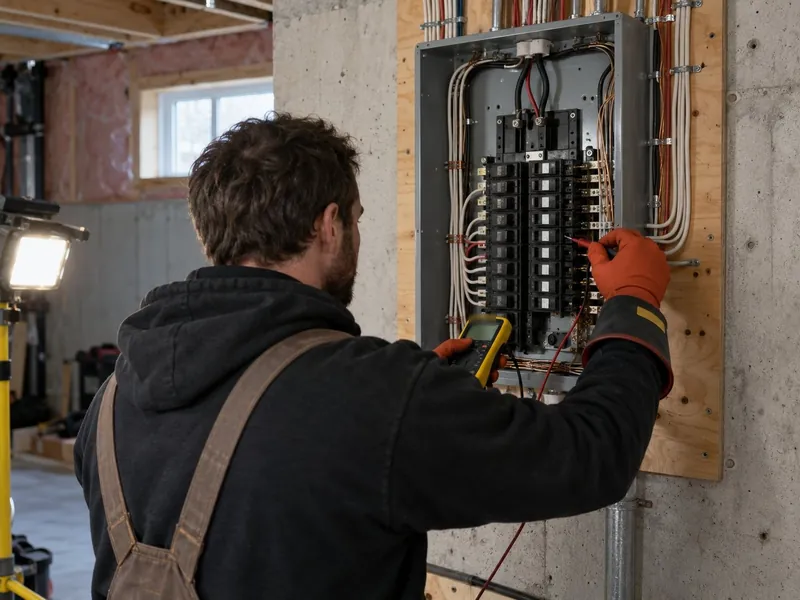
- A photo of the open panel showing the tripped breaker and its label
- Any wording on that breaker, such as AFCI or GFCI, and whether it has a test button
- How soon it trips after a reset, and what was running at the time
- Make and model of any appliance you suspect
- Build year of the house, and any renovation on that circuit
Questions people ask
Is it safe to keep resetting a breaker that trips again?
ESA’s homeowner handbook lists circuits that frequently trip as a sign of overloading or faulty wiring or equipment, which can cause a shock or fire, and says to contact a Licensed Electrical Contractor as soon as possible. Put the number of resets you tried in the request.
A bedroom breaker with a test button trips when nothing heavy is running. Is it faulty?
A breaker with a test button is a GFCI or AFCI type, and each can trip on a fault in the wiring, in a plugged-in device or in the breaker itself. ESA asks contractors to report suspected AFCI nuisance tripping to Electro Federation Canada, with the make, model and serial number of the breaker and of the equipment involved.
Will a panel upgrade stop one circuit from tripping?
ESA’s bulletin says a panel replacement alone brings no duty to add arc-fault protection to existing circuits. The Ottawa firm lists a new dedicated circuit at $200–$500 against $1,800–$4,000 for 100 A to 200 A.
The block heater outlet trips on cold mornings. What do I tell the company?
Outdoor receptacles within 2.5 m of finished grade need Class A GFCI protection under Rule 26-704, and ESA confirms block heaters get no exemption. Say which outlet and what the weather was when it tripped.
Does a tripping breaker visit cost more at night?
HomeStars’ 2026 guide puts after-hours work at 1.5 to 2 times the daytime rate, and some companies set a two to four hour minimum for emergency calls.